

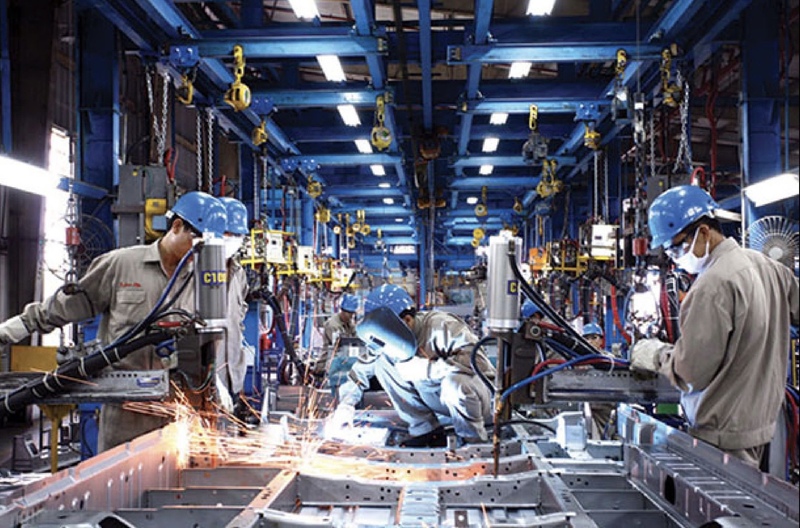
Government Resolution No. 82/NQ-CP on policies for key industries is expected to create a shift from growth based on scale to growth based on quality.
The Government’s issuance of Resolution No. 82/NQ-CP dated April 3, 2026, approving the policy of the Law on Key Industries, demonstrates an institutional move that reorients the structure of Vietnam’s industrial development in the new phase.
As industry continues to be identified as a pillar of the economy , the demands are not only for growth but also for upgrading quality, enhancing self-reliance, and the ability to participate deeply in global value chains.
Creating a policy framework to address bottlenecks in industrial development.
Resolution 82/NQ-CP clearly demonstrates the Government’s consistent stance on the necessity of developing a Law on Key Industries to institutionalize the policy of industrialization and modernization of the country. A notable point is the shift in the industrial development model from extensive to intensive, from processing and assembly to research, design, and production with high technological content.
The government has basically agreed on the content of the two policies proposed by the Ministry of Industry and Trade , including encouraging domestic production and manufacturing of key industrial products and developing supporting industries.
This shows that the policy has correctly identified the key areas that need to be prioritized for more sustainable industrial development. In particular, the gradual improvement of the supporting industrial ecosystem is expected to create conditions for domestic businesses to enhance their capacity to participate more deeply in the supply chain, while also more effectively utilizing the incentives from free trade agreements.
According to data from the Department of Industry (Ministry of Industry and Trade), in 2025, the processing and manufacturing industry will account for approximately 24.5% of GDP, creating an important foundation for economic growth. The goal of increasing this proportion to about 28% by 2030 is considered entirely feasible if strong and timely policies are implemented.
The industry still has significant growth potential, especially as Vietnam continues to attract investment, expand its markets, and participate more deeply in global value chains. Issues such as dependence on imported raw materials, technological limitations, and linkages between domestic businesses and FDI companies are gradually being clearly identified and becoming key areas for reform, thereby opening up opportunities to enhance the industry’s self-reliance and competitiveness in the coming period.
Therefore, the design of this key Industrial Law aims to address fundamental bottlenecks, from preferential mechanisms for domestic production and promoting localization, to establishing clear criteria for the localization rate as a basis for supporting businesses. This is a crucial element in meeting the rules of origin in international trade, thereby helping Vietnamese goods not only penetrate but also maintain a strong position in major markets.
Another key aspect of the policy direction is the requirement to link industrial development with science, technology, and innovation. This shows that the approach is no longer limited to expanding production scale but focuses on increasing added value. As global value chains increasingly restructure, the advantage of cheap labor is no longer sufficient, making technological upgrading a mandatory condition.
Simultaneously, the government has also requested a review and improvement of the relevant legal system to ensure consistency, uniformity, and avoid overlaps. This is an issue that has previously caused many difficulties for businesses, as regulations on investment, environment, and science and technology have not been effectively interconnected. The acceleration of decentralization, delegation of authority, reduction of administrative procedures, and promotion of digital transformation in state management are expected to create a more favorable environment for industrial development.
Towards a self-reliant industry.
One of the key aspects of the policy is the development of a mechanism for attracting and managing FDI in a selective manner. Instead of prioritizing quantity, foreign investment projects will be screened based on criteria such as high technology, spillover effects, and the degree of linkage with domestic businesses. This is a necessary shift to avoid the prolonged situation of mere “assembly” and to enhance national production capacity.
Linking technology transfer requirements to attracting FDI also demonstrates a clear direction in leveraging external resources to develop domestic capabilities. If implemented effectively, this policy could create a genuine connection between the FDI sector and domestic businesses – something that has been lacking for many years.
From an expert’s perspective, in an interview with a reporter from the Industry and Trade Newspaper, Mr. Nguyen Van Hoi, Director of the Institute for Strategic and Policy Research in Industry and Trade, emphasized that industry is the core foundation of the economy, playing a central role in the growth structure. In recent years, the industrial sector has made significant contributions to exports and consumption, creating an important foundation for economic development.

To accelerate progress towards the goal of industrialization and modernization, further improving the policy system in a synchronized manner, along with the development of a comprehensive law for the industrial sector, will open up new opportunities, helping to more effectively exploit potential and improve the quality of growth.
Based on that reality, the development of a Law on Key Industries is considered a necessary step, but it also requires ensuring its consistency with related laws. A single law will be difficult to be effective without a comprehensive adjustment of regulations on investment, environment, science and technology, and trade.
Notably, the proposal to develop industrial planning based on value chains, linking industries, regions, and localities, reflects a new development mindset. Instead of scattered development, industry needs to be organized into interconnected clusters where businesses can leverage economies of scale, share infrastructure, and improve production efficiency.
Identifying key industries such as energy and electricity is also crucial. These not only provide inputs for production but also determine the development potential of the entire industrial system. Furthermore, developing industries along the value chain, such as the dairy industry or agricultural processing industries, can create a strong ripple effect, reducing imports while increasing domestic value.
” The target of industrial growth of around 10-11% per year is considered reasonable, but to achieve it, a sufficiently strong and consistent policy ecosystem is needed. This includes supporting businesses in improving technological capabilities, accessing finance, expanding markets, and participating more deeply in global supply chains ,” Mr. Nguyen Van Hoi commented.
The policies of the Key Industrial Law aim not only to address immediate problems but also to build an independent, self-reliant, and resilient industrial base. As global economic uncertainties increase, the internal capacity of the manufacturing sector becomes a decisive factor.
The government’s early completion of the policy document, ensuring its constitutionality, legality, and compliance with international commitments, while fully incorporating the opinions of the National Assembly’s agencies, will be a crucial prerequisite for the Law on Key Industries to truly come into effect. If designed and implemented effectively, this law could create a major impetus, helping Vietnamese industry move into a new phase of development, where growth is based not only on scale but also on quality, technology, and competitiveness.
*Source: Vietnam.vn