

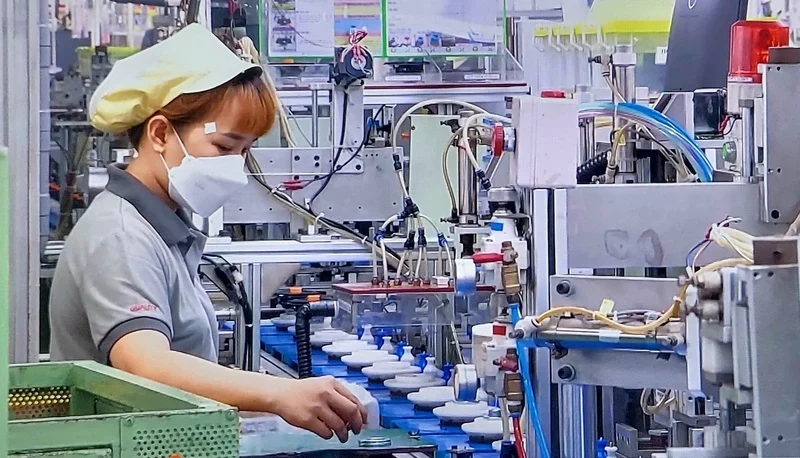
The Government’s issuance of a Resolution on the adoption of the Key Industrial Policy is considered a “lever” for Vietnam to realize its goal of becoming a modern industrialized country.
Aiming to build a self-reliant industry.
The Prime Minister has just issued Resolution No. 82/NQ-CP on the adoption of the Policy for the Law on Key Industries. In the Resolution, the Government agrees to develop a Law on Key Industries to institutionalize the Party’s guidelines and viewpoints on industrialization and modernization of the country, to complete the legal framework promoting the development of key industries in line with the context of science, technology, and innovation, aiming to build an independent, self-reliant, and strong industrial base, contributing to rapid and sustainable economic development, becoming a developed, high-income country in accordance with socialist orientation, and meeting practical requirements and socio-economic development requirements in the coming period.
Specifically, the Government has basically agreed on the content of the two policies proposed by the Ministry of Industry and Trade , including: Policy 1 : Encouraging domestic production and manufacturing of key industrial products; Policy 2 : Developing supporting industries.
At the same time, the Ministry of Industry and Trade is directed to take the lead and coordinate with relevant ministries and agencies to research and incorporate the opinions of Government members to finalize the policies of the Law on Key Industries as prescribed, ensuring the following requirements: institutionalizing the Party’s guidelines and viewpoints on the development of key industries; creating a number of policies and laws to address fundamental bottlenecks in the development of key industries, shifting from extensive to intensive development, from processing and assembly to research, design, and production in Vietnam with high knowledge and technology content, while creating a breakthrough in the modernization process of industry.
Encourage the promotion of appropriate localization to meet the requirements and preferential rules of origin in international trade; in line with bilateral and multilateral trade agreements and the requirements of major markets. Design mechanisms to encourage Vietnamese businesses to participate more deeply in global supply chains, taking advantage of preferential treatment from new generation free trade agreements through guaranteed rules of origin.
The resolution also aims to establish regulations for attracting and managing foreign direct investment (FDI) in key industries in a selective manner, prioritizing high-tech and foundational industry projects; while simultaneously linking them to technology transfer requirements and partnerships with domestic enterprises, contributing to enhancing national production capacity.
Review the implementation of current legal regulations to develop content that is consistent with reality, feasible, and addresses existing shortcomings, limitations, obstacles, and inadequacies; harmonize with relevant international treaties to which Vietnam is a signatory; review policy and legal documents to ensure consistency and uniformity with related laws; promote decentralization and delegation of power in state management of key industrial development; reduce and simplify administrative procedures, and promote the application of science and technology and digital transformation.
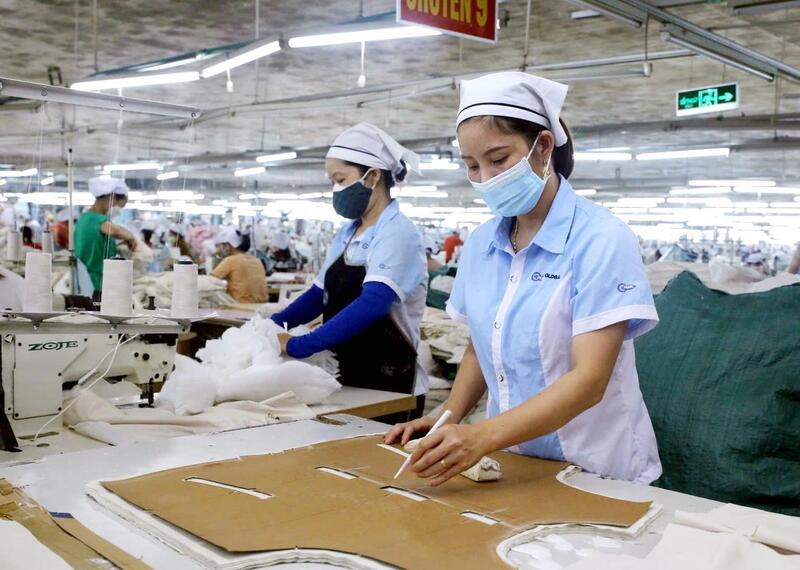
“Leverage” for the goal of transforming Vietnam into a modern industrialized nation.
Resolution No. 29-NQ/TW dated November 17, 2022, of the 6th Conference of the Central Committee of the 13th Party Congress on continuing to promote industrialization and modernization of the country until 2030, with a vision to 2045, sets the following goals: Implementing industrialization and modernization requires a specific roadmap and steps, with a focus on key areas; prioritizing resources, and having breakthrough and appropriate mechanisms and policies to develop growth poles, foundational industries, priority industries, leading industries, supporting industries, and high value-added service sectors; prioritizing the construction and completion of specialized legal systems on national industrial development and specific industrial sectors.
Speaking with a reporter from the Industry and Trade Newspaper, economist Dr. Le Dang Doanh – former Director of the Central Institute for Economic Management Research (Ministry of Planning and Investment, now the Ministry of Finance) – highly praised the Government’s approval of the policy outlined in the Law on Key Industries.
According to Dr. Le Dang Doanh, the government’s adoption of the policy to develop a Law on Key Industries in the current context is extremely necessary and urgent, aiming to institutionalize the Party’s guidelines on industrialization and modernization of the country, towards the goal of 2030, with a vision to 2045.
According to Dr. Le Dang Doanh, in reality, Vietnamese industry has mainly focused on assembly over the past period, resulting in low added value and limited application of science and technology. Therefore, the enactment of the Law on Key Industries is expected to create a shift from extensive to intensive development, promoting fundamental industries, processing and manufacturing industries, and gradually forming endogenous industrial value chains in Vietnam.
However, for the policy to be effective, special attention should be paid to promoting linkages between domestic enterprises and FDI enterprises, as well as with research institutes and universities, in order to enhance technological capacity and innovation.
Dr. Le Dang Doanh emphasized that the level of industrial contribution to economic growth in the 2026-2030 period will largely depend on the effectiveness of this policy implementation. If successfully implemented, Vietnam can increase its production capacity, create high-value products, and enhance its position in the global value chain, affirming Vietnam’s place on the world industrial map.
Resolution No. 82/NQ-CP requires the Ministry of Industry and Trade to take the lead and coordinate with relevant ministries and agencies to draft the Law on Key Industries, and report to the Government as prescribed. During the drafting process, it is necessary to ensure that the draft law does not overlap with existing relevant legal provisions, is consistent with international commitments in attracting FDI, and creates favorable conditions for the strong development of key industries in accordance with the Party’s guidelines and policies.
*Source: Vietnam.vn