
Vietnam and Canada have the opportunity to elevate cooperation in science, technology, and innovation from isolated projects into structured programs with tangible economic value and specific products, with artificial intelligence, aerospace, and strategic technologies poised to become breakthrough areas.
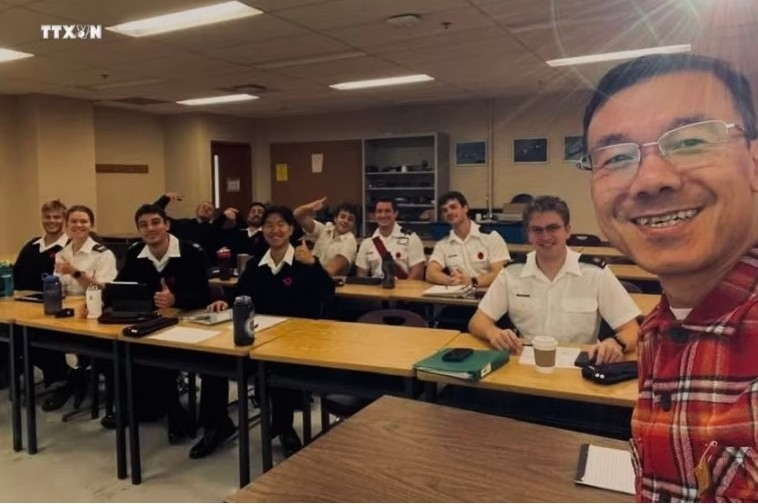
This assessment was shared by Associate Professor Vu Viet Hung from the Department of Mechanical and Aerospace Engineering at the Royal Military College of Canada in a recent media interview in Ottawa ahead of the State visit to Canada by General Secretary of the Communist Party Central Committee and President To Lam.
According to Vu Viet Hung, President of the Network of Vietnamese Experts and Scientists in Canada (CVSEA), both Vietnam and Canada increasingly view artificial intelligence, quantum technology, clean energy, and aerospace as technological fields of strategic significance. In the near term, Vietnam can proactively boost deeper cooperation across two primary directions: artificial intelligence applications and aerospace technology.
In the field of artificial intelligence, Vietnam does not necessarily need to start by racing to develop large-scale foundational models; instead, it can focus more on application and commercialization.
Canada possesses a highly developed AI research ecosystem and robust research capabilities. Meanwhile, Vietnam offers a large market for practical AI integration, featuring a dynamic economy, a young population, a growing tech workforce, and a relatively rapid capacity for testing new models.
Consequently, combining Canada’s research and technological capabilities with Vietnam’s implementation capacity can create a distinctly complementary form of cooperation.
Vu Viet Hung noted that the initial stage can prioritize software-based AI applications, or “virtual AI,” within sectors capable of rapid deployment. “Physical AI” applications, AI integrated with robots, sensors, materials, and production systems, also hold huge potential, though they require greater capital, longer timeframes, and the synchronized development of multiple technology sectors.
Aerospace is another sector that Vietnam should pay special attention to. According to the Associate Professor, this is not merely a high-tech industry; it is increasingly tied to telecommunications, Earth observation, resource management, security, defence, and national technological autonomy.”
Canada maintains a developed aerospace industry and is actively seeking to expand its technology partnerships and markets beyond traditional allies. This presents an opportunity for Vietnam to access civilian products and technologies while gradually engaging more deeply in research, training, technology transfer, and the development of dual-use technologies.
From a broader perspective, Vu Viet Hung emphasized that the critical challenge lies not only in identifying areas of cooperation but also in establishing mechanisms to turn research into products and economic value.
Nearly a decade after establishing the Comprehensive Partnership framework in 2017, changes in geopolitics, supply chain restructuring, and the need to diversify partners create favorable conditions for Vietnam and Canada to consider elevating their relations to deeper levels of cooperation, with science and technology serving as a core pillar.
Vu Viet Hung suggested that the two sides could first study the establishment of a joint research and development co-funding mechanism, such as linking Vietnam’s National Foundation for Science and Technology Development (NAFOSTED) with Canada’s Natural Sciences and Engineering Research Council (NSERC), or creating a Vietnam-Canada innovation funding program to enable research institutes, universities, and businesses from both nations to participate jointly.
Another direction involves forming innovation programs with direct business participation, linking research with market demand, and maintaining regular business-technology forums between the two countries. According to Vu Viet Hung, connecting the research community without business involvement makes it difficult for commercialized research results to achieve scale.
Regarding training and human resources development, he proposed piloting joint university-research center or program models within strategic fields, built upon cooperation between strong academic and research institutions in both countries. These centers could simultaneously conduct training, research, technology transfer, and bridge researchers with enterprises.
Additionally, appropriate financial, tax, and market-support incentives are necessary for enterprises and technology startups participating in cooperative, investment, or technology transfer programs between Vietnam and Canada.
The network of Vietnamese scientists and experts in Canada can also play a substantial role in this process. CVSEA, a legally incorporated entity in Canada, can serve as a bridge connecting management agencies, universities, research institutes, and businesses in both nations, Hung added.
He stated that Vietnamese experts can introduce partners as well as participate directly in designing cooperation programs, identifying suitable fields, connecting research teams, and facilitating specific projects. Once cooperation mechanisms are operational, this network can continue acting as a catalyst to connect resources across the Pacific.
Vu Viet Hung concluded that if political momentum from high-level contacts is turned into long-term cooperative mechanisms, science, technology, and innovation can move beyond academic exchanges and isolated projects to become a substantive pillar of Vietnam-Canada relations, generating concrete products, enterprises, and economic value for both nations.
Source: VOV.VN