


The Ministry of Industry and Trade has just issued Decision No. 363/QD-BCT dated February 28, 2026, approving the adjustment of the National Energy Master Plan for the period 2021-2030, with a vision to 2050.
Accordingly, the Minister of Industry and Trade has officially approved the revised national energy master plan for the period 2021-2030, with a vision to 2050.
In terms of scope, the revised plan covers sub-sectors including oil and gas, coal, electricity, new energy and renewable energy; and encompasses the entire chain of activities from basic investigation, exploration, drilling, extraction, production, storage, distribution to consumption and related activities.
Specifically in the coal sector, the adjustments focus on forecasting supply and demand, developing infrastructure systems to support production, processing, transportation, storage, and import/export activities.
Regarding development orientation, the plan emphasizes the need for close integration between energy development and socio-economic development strategies, ensuring the optimization of the overall energy system in a forward-looking and sustainable manner. At the same time, it continues to diversify supply sources to fully and stably meet the energy needs for socio -economic development and the process of industrialization and modernization in the context of the Fourth Industrial Revolution.
The exploitation and utilization of domestic energy resources must be carried out rationally and efficiently, combined with imports, in order to conserve resources and ensure national energy security.
Furthermore, the plan aims to develop a competitive energy market, diversify ownership forms and business methods, and ensure a balance of consumer interests; while also promoting the elimination of subsidies and moving towards completely removing the integration of social policies into energy prices.
In terms of objectives, the revised plan prioritizes ensuring national energy security. Specifically, it aims to fully meet domestic energy needs, serving the goal of achieving an average GDP growth of at least 10% per year during the 2026-2030 period.
Total final energy demand is projected to reach approximately 120-130 million tons of oil equivalent by 2030 and 175-200 million tons by 2050. Correspondingly, total primary energy supply is expected to reach approximately 150-170 million tons by 2030 and 210-250 million tons by 2050. Simultaneously, the goal is to increase national petroleum reserves to approximately 90 days of net imports by 2030.
Regarding the just energy transition, the plan aims for renewable energy to account for approximately 25-30% by 2030 and increase to 70-80% by 2050. Energy savings are projected to reach approximately 8-10% of total final consumption by 2030 compared to the business-as-usual scenario. Greenhouse gas emissions are targeted to decrease by 15-35% by 2030, with total energy sector emissions of approximately 433-474 million tons of CO2 equivalent, reduced to around 101 million tons by 2050. The target of peak emissions by 2030 is linked to the full implementation of commitments under the Just Energy Transition Framework (JETP).
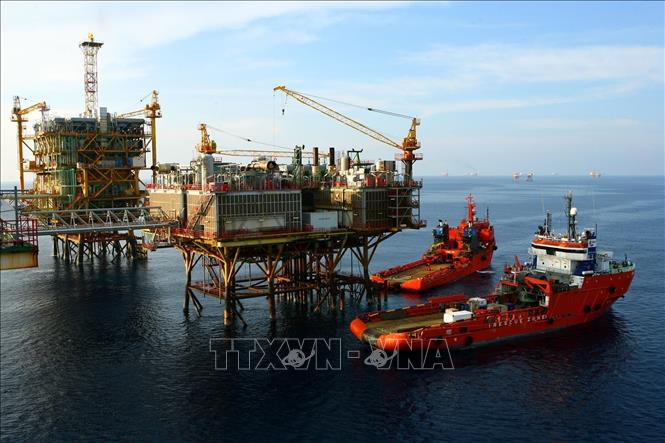
For the development of the energy industry, the plan requires the efficient exploitation of domestic resources. Crude oil production is projected to reach 5.8-8 million tons/year in the period 2026-2030; 6-10 million tons/year in the period 2031-2035; and 4.8-7.8 million tons/year in the period 2036-2050.
Natural gas production is estimated to reach 5.4 – 11.0 billion m³/year in the period 2026 – 2030; 9 – 15 billion m³/year in the period 2031 – 2035; and is projected to reach 14 – 18.8 billion m³/year in the period 2036 – 2050.
The plan also addresses the full development of LNG import capacity to serve gas-fired power plants and other needs; and the formation of appropriate LNG energy centers in each region. Coal industry infrastructure is oriented towards synchronized development, interconnected between regions and linked with the infrastructure of related industries.
Notably, the revised plan aims to develop the energy industry into a regional hub for clean energy and renewable energy exports. Renewable energy centers will be established in areas and localities with competitive advantages.
By 2030, it is expected that several clean energy centers will be established in the Red River Delta, South Central Coast, Central Highlands, and Southeast region, with activities such as energy production and utilization, equipment manufacturing, oil and gas processing, construction, and related services when conditions are favorable.
Simultaneously, the plan promotes the development of new energy sources to serve both the domestic and export markets. The goal is to achieve a green hydrogen production capacity of approximately 100-200 thousand tons per year by 2030, and to increase it to 10-20 million tons per year by 2050.
*Source: Vietnam.vn